
"¿Pensas que aquellos que amamos nos dejan cuando ya no estan entre nosotros? ¿ Pensas que no vendran a ayudarnos en momentos que necesitemos su presencia ? Lo cierto es que estan vivos dentro nuestro y solo debemos llamarlos cuando los necesitemos" Professor Albus Percival Wulfric Brian Dumbledore [1881-1997] Harry Potter y el Prisionerto de Azkaban


Las mujeres se animan a mas si estan acompañadas de otras mujeres
Women backed by women: taking risks
November 29, 2011
(PhysOrg.com) -- New research from The Australian National University has shown that women are more likely to make risky choices when they are surrounded by other women. The findings could help to reduce gender inequality in the workforce.

-
In an experiment at the University of Essex, Professor Alison Booth from the ANU Research School of Economics and colleagues, tested whether single-sex classrooms in co-educational environments altered students’ risk-taking attitudes.
Professor Booth said the results showed risk-taking in women came down to social learning and environmental factors, rather than inherent gender traits.
“We designed a controlled experiment using first-year university students who made choices over real-stakes lotteries at two different dates. Students were randomly assigned to classes of three types: all female, all male, and co-educational. They were not allowed to change group subsequently,” said Professor Booth.
“We found that on average women are less likely to make risky choices than men at both dates. However, after eight weeks in a single-sex environment, women were significantly more likely to choose the lottery than their counterparts in co-educational groups. Indeed, by week eight women in all-female groups behaved in a similar way to men. It was also interesting to note that the risk-taking behaviour of men was unaffected by group composition.
“Women, even those endowed with an intrinsic propensity to make riskier choices, may be discouraged from doing so because they are inhibited by culturally-driven norms and beliefs about the appropriate mode of female behaviour-avoiding risk. But once they are placed in an all-female environment, this inhibition is reduced.”
Professor Booth said that the findings had implications for the labour market.
“Recent studies in experimental economics have shown that, on average, women are more risk averse than men. If much of the remuneration in high‐paying jobs consists of bonuses linked to a company’s performance, relatively fewer women will choose high‐paying jobs because of the uncertainty.
“This is why these findings are important. They show that risk-taking behaviour is not necessarily innate – it can be affected by the environment in which the individual is placed.
“Given that risk attitudes can be shaped by the environment, changing the educational or training context could help address under-representation of women in certain areas.”
Provided by Australian National University

El cuerpo de Barbie vs el de una Mujer / "Mujeres feas no hay mas , solo maridos pobres" #frasesdelanoche
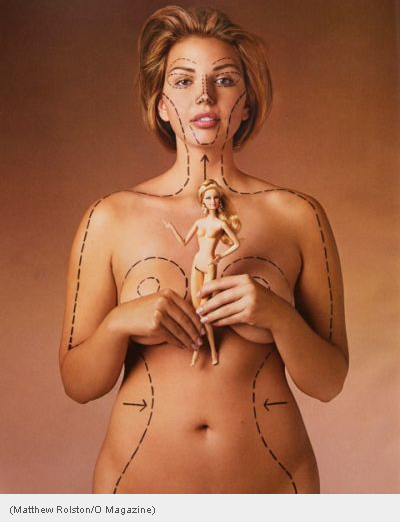
We are trapped in a narcissistic world of images, where we must self-surveil our bodies with beauty as one of our primary goals. We invest in and manipulate our bodies and engage in body regimes to cultivate our physiques, often towards unattainable goals of perfection. We become subjects (in the Foucauldian sense) to our own projects of becoming, as we police ourselves and internalize a normalizing gaze. The only way to achieve these kinds of bodies, like Barbie’s proportions in this image, is through dramatic, invasive cosmetic procedures. Yet, we still labor over our bodies, continually trying to shape it in accords of dominant ideals. We have forgotten (or simply ignored) that these kinds of bodies are fantastical images.


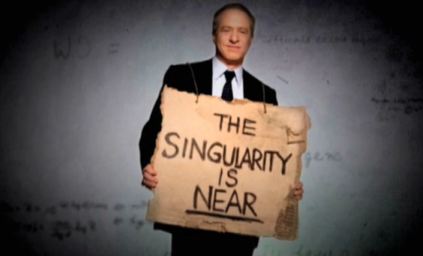
Ray Kurzweil - Transcendent Man -
"Algun dia el hombre vivira para siempre"
Ray Kurzweil, Founder and CEO, Kurzweil Technologies


Subscribe to:
Posts (Atom)